Top 5 Emerging Tech Trends of 2024
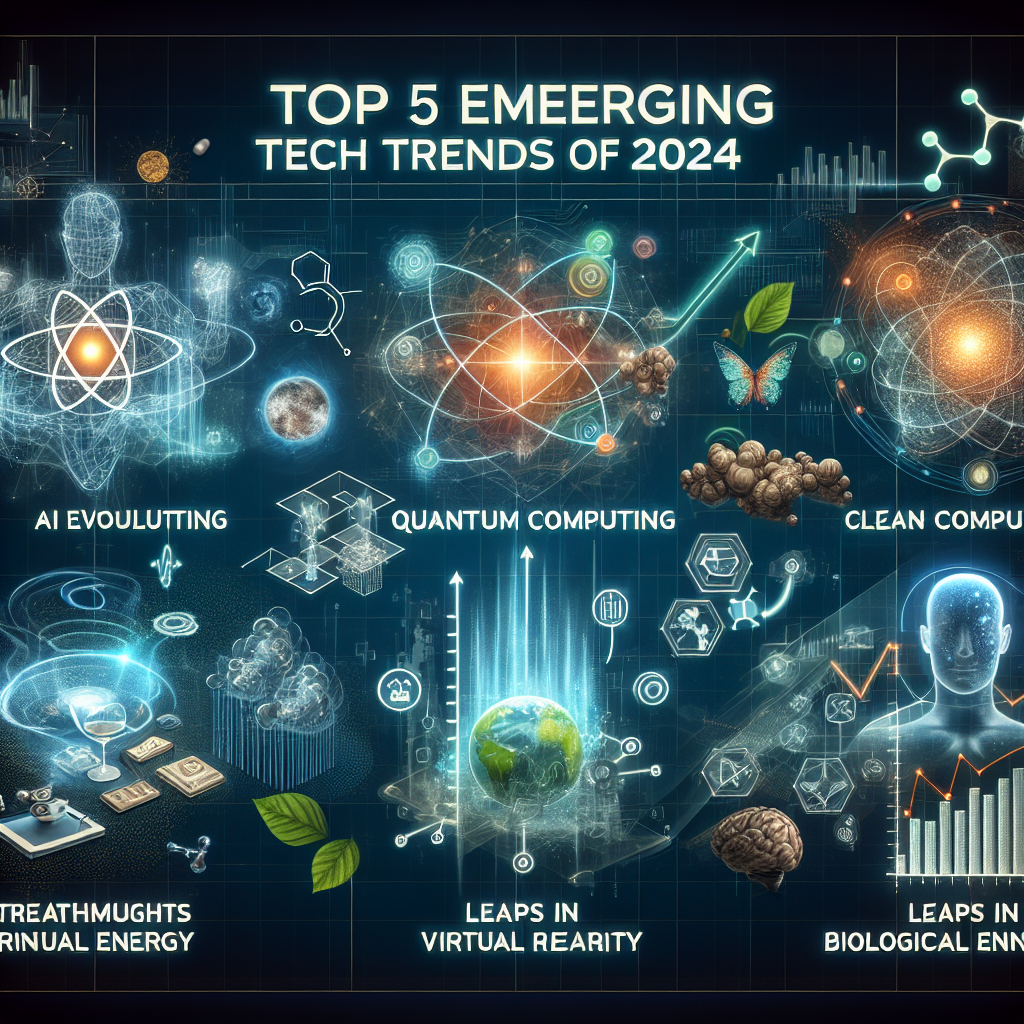
1. Artificial Intelligence and Machine Learning Advancements
Artificial Intelligence (AI) and Machine Learning (ML) continue to lead the technological revolution. In 2024, these technologies are expected to be more integrated into everyday life than ever. According to a recent report by McKinsey, AI is projected to add around $13 trillion to the global economy by 2030, enhancing business processes, predicting customer behavior, and enabling automation on an unprecedented scale.
One of the key advancements expected this year is the increased use of AI in generative applications. These applications can create new content, simulations, and designs efficiently and effectively. Industries like healthcare and entertainment are already leveraging AI to personalize services and improve user experiences, pointing towards a significant shift in how we interact with technology.
2. Quantum Computing Breakthroughs
Quantum computing, once a theoretical concept, is now on the verge of practical application. In 2024, we anticipate key breakthroughs that will make quantum computing more accessible to various industries. A report from Gartner suggested that by 2025, quantum computing will deliver significant business value across numerous sectors, including finance, pharmaceuticals, and logistics.
The processing power of quantum computers can solve complex problems in minutes, which would take classical computers thousands of years. For example, companies like IBM and Google are racing to develop quantum chips that will allow for more substantial computations. This rapid evolution could lead to innovations in drug discovery, cryptography, and supply chain management, fostering a new wave of efficiency and problem-solving capabilities.
3. Extended Reality (XR) Adoption
Extended Reality, which encompasses Virtual Reality (VR), Augmented Reality (AR), and Mixed Reality (MR), is set to become more mainstream in 2024. The global XR market is projected to grow from approximately $30 billion in 2021 to over $300 billion by 2024, according to Statista. This phenomenal growth signals a fundamental shift in how we perceive our environment and interact with digital information.
The gaming industry is the initial leader in XR adoption, but applications are rapidly expanding into education, healthcare, real estate, and remote work. For instance, XR can create immersive training environments for medical professionals or simulate real estate tours. Major tech companies are investing heavily in XR technologies, and consumer adoption is expected to surge as devices become cheaper and more accessible.
4. 5G Connectivity Expansion
The advent of 5G technology is revolutionizing connectivity and paving the way for advancements in smart cities, autonomous vehicles, and the Internet of Things (IoT). By 2024, an estimated 1.7 billion 5G connections are expected globally, and the market is predicted to grow from $57 billion in 2020 to over $700 billion by 2027, according to a study by Fortune Business Insights.
5G offers significantly faster speeds and lower latency, which will facilitate real-time data exchange and enable applications that were previously infeasible. Industries such as manufacturing and logistics will see optimization in operations through enhanced connectivity, while consumers will benefit from improved streaming and gaming experiences. This expansion of connectivity lays the groundwork for smarter applications and innovations across various sectors.
5. Sustainable Tech Innovations
As climate concerns grow, technology is increasingly being developed with sustainability in mind. By 2024, sustainable technology initiatives are expected to dominate both corporate and consumer coming intentions, focusing on reducing carbon footprints and enhancing energy efficiency. The International Energy Agency (IEA) estimates that over $4 trillion will be invested globally in renewable energy technologies by 2025.
Innovations in carbon capture, renewable energy solutions, and electric mobility, will be at the forefront of this movement. Companies are using AI to optimize energy consumption and implementing smart grids that enhance energy efficiency. Additionally, electric vehicle adoption is projected to reach around 30% of total new car sales globally by 2030, up from approximately 10% in 2022, highlighting a pivotal change towards cleaner transportation.
Conclusion
The technology landscape is steadily evolving, and the trends of 2024 are indicative of a future where innovation is intertwined with daily life. The convergence of AI and ML with practical applications, the acceleration of quantum computing, the proliferation of XR, enhanced connectivity via 5G, and a commitment to sustainable technologies exemplify the relentless march toward progress.
These emerging tech trends not only hold significant potential to reshape industries but also to improve our quality of life. As businesses and consumers adapt to these innovations, those who remain informed and proactive in their adoption will be well-positioned for success in this rapidly changing environment. Embracing these trends now will pave the way for greater efficiency, sustainability, and enhanced user experiences in the coming years.


Post Comment